Crude Oil Desalter Applications for the ID-200
Precision Today, Uptime Tomorrow.
Crude oil desalting is a critical step in refinery operations, during which salt, water, and suspended solids are removed from crude oil before processing. Effective separation ensures equipment longevity, reduces corrosion, and maintains product quality. The Agar ID-200 Series Interface Detector is specifically engineered to support this process with high-accuracy interface measurement and automatic tank dewatering. Trusted by engineers worldwide, the ID-200 helps eliminate hydrocarbon loss, improve efficiency, and ensure safe, repeatable separation in demanding industrial environments.
What Is a Crude Oil Desalter and Why It Matters
The desalter operates by mixing crude oil with wash water and applying electrostatic fields to separate the water phase (which contains dissolved salts) from the oil. Accurate and reliable interface detection is essential in this process to ensure optimal water draw-off without losing valuable hydrocarbons.
That’s where the Agar ID-200 Series Interface Detector stands out as the industry leader. With precision down to low ppm levels, robust materials for harsh environments, and real-time interface monitoring, the ID-200 helps refineries maximize throughput, reduce chemical usage, and eliminate costly hydrocarbon loss—especially during the critical dewatering phase of the desalter.
Why the Agar ID-200 Is Essential in Desalter Applications
Accurate Interface Measurement
Distinguishes between oil, water, and emulsions with high accuracy—preventing cross-contamination.
Automatic Tank Dewatering
Automates separation processes to draw off water efficiently without wasting.
Proven in Harsh Conditions
Withstands high temperatures, pressures up to 3000 PSI, and corrosive environments.
Compliance & Integration
NACE-compliant and available with 4-20mA HART communication for seamless integration into plant control systems.
Substantial Cost Savings
Helps reduce hydrocarbon losses and chemical overuse—some users report savings of up to £1.9 million annually.
REFINERY CONTROL STARTS AT THE INTERFACE
Stabilising the Desalter Where Problems Actually Start
Crude oil desalters rarely lose efficiency because of one single issue. In most cases, the problem begins at the oil, water and emulsion interface, where poor visibility can lead to unstable separation, excess water draw-off, hydrocarbon carryunder, high slop oil generation and unnecessary chemical dosing.
For refinery operators and process engineers, this is not just an instrumentation issue. It directly affects crude unit reliability, wastewater loading, heat exchanger fouling, corrosion risk and overall process efficiency.
The Agar ID-200 gives operators a continuous view of the interface layer inside the vessel, helping them control the water draw-off point with greater confidence. By detecting the difference between oil, water and emulsion, the ID-200 supports more stable desalter operation and helps reduce the risk of valuable hydrocarbons being sent to drain or wastewater treatment.
Common Desalter Problems the ID-200 Helps Address
Unstable Emulsion Layers
Heavy crude, changing feedstock quality and incorrect chemical dosing can create a difficult rag layer between the oil and water phases. The ID-200 helps operators monitor this changing interface in real time, giving better visibility of what is happening inside the vessel.
Hydrocarbon Loss to Wastewater
If the interface is not accurately controlled, oil can be pulled out with the brine. This increases slop oil handling, wastewater loading and lost product value. The ID-200 helps maintain the correct draw-off point to reduce unnecessary hydrocarbon loss.
Overuse of Demulsifier Chemicals
Without reliable interface feedback, chemical dosing can become reactive rather than controlled. Better interface measurement helps process teams fine-tune separation performance and avoid unnecessary chemical consumption.
Fouling, Corrosion and Downstream Risk
Poor desalter performance can allow more salts, solids and water to pass forward into the process. This can contribute to fouling, corrosion and reduced equipment life. By improving control at the separation stage, the ID-200 supports a more stable and reliable crude oil desalting process.
Built for Refinery Conditions
The ID-200 is designed for demanding refinery environments where high temperature, high pressure, corrosive media and variable crude quality are part of daily operation. With robust wetted materials, 4-20 mA HART communication and proven interface detection technology, it gives engineers a practical way to improve control without adding unnecessary complexity.
Better interface control means fewer assumptions, fewer manual interventions and a more stable desalter.
ID200h Series Enhanced Connectivity and Power Efficiency
Sensor features
The ID200h Series stands out with its 2 Wire loop-powered system and HART communication protocol, offering seamless integration and enhanced energy efficiency. It is ideal for sophisticated control systems requiring advanced communication capabilities.
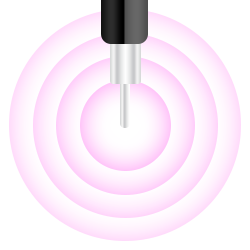
A hight-frequency, low-power energy is broadcast.

The detection range is a 3″ sphere around the tip.

Some of the energy is absorbed by the medium surrounding the antenna.

The analogue signal is generated relative to the absorption rate.
Industries and Applications that Rely on the ID-200
The ID-200 is trusted globally across upstream, midstream, and downstream operations for its adaptability and performance in complex separation processes
Refineries (Downstream)
- Crude Oil Desalters
- Finished Product Storage Tanks
- Slop Oil Recovery Systems
- Sour Water Strippers
- Amine Units
- API Separators
Production Facilities (Upstream)
- Three-Phase Separators
- Free Water Knockouts (FWKO)
- Coalescers
- Dehydrators
- Test Separators
Water Treatment & Environmental
- Wastewater Treatment Plants (WWTP)
- Emulsion Separation Tanks
- Produced Water Handling Systems
Chemical & Petrochemical
- Reactors and Settlers
- Demulsifier Feed Systems
- Automatic Defoamer Controls
Technical resources
Automatic tank dewatering system guide
Process sequence, control logic and practical planning questions for reliable automated water draw-off.
How crude oil desalters work
A practical overview of wash water, electrostatic separation, interface behaviour and emulsion control.
ID-200H specifications and installation planning
Published ranges, wetted materials, electrical connections and a commissioning checklist for project planning.
Trusted by some of the best in the industry


Unique 4-phase technology
Our innovative 4-phase technology, designed to optimize the removal of water, oil, gas, and solids from your process streams. This advanced system ensures precise interface detection and control, reducing contamination and enhancing overall performance.
Saving you millions
By installing ID-200 Interface Detectors, a US refinery reduced its total HC being dumped to the WWTS by 82% with better interface/separation control. An 82% reduction in SLOP OIL generated equals £1,990,424 per year in savings/additional profit. Not just for the first single year but continuing year after year.
82% reduction in slop oil waste
nationwide support
Contact our experts
To find out more about the ID-200, request a callback, or have a highly technical question, our expert staff are always on hand. Our focus has always been to deliver world-class customer service.
All great relationships start with a conversation
To contact us, or to request a callback, simply use this form and we will promptly get back to you.